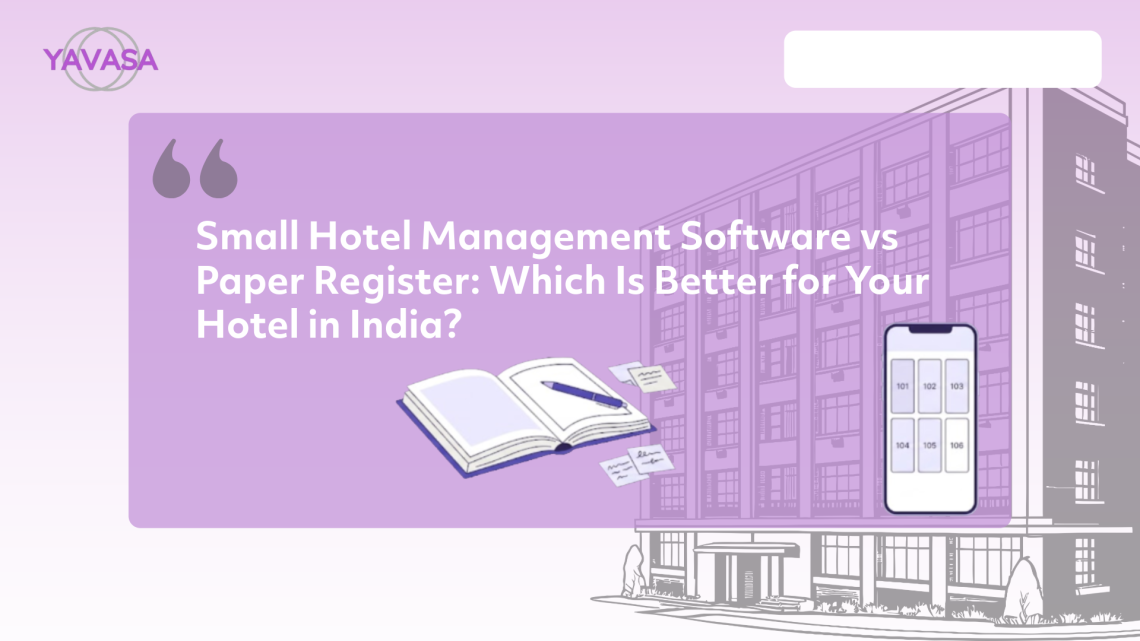
If you run a small hotel, guest house or dharamshala, there is probably a thick register on your counter. Every guest is written in it by hand, and it has worked for years.
But more owners now ask: should I move to small hotel management software?
The answer depends on your hotel. A register is good at some things, and software is good at others. This post compares both honestly, so you can decide for yourself.
Why the paper register has lasted so long
Owners who say “my register is fine” are not wrong. A register has real strengths:
- No learning needed. Your staff already knows how to use it.
- It works in a power cut. It needs no electricity and no internet.
- It costs almost nothing. A register and a pen are cheap.
- You see everything at a glance. Flip the page and you know who is in which room.
If you have 4 to 6 rooms and few bookings, a register can work well. The trouble starts when your hotel gets busy.
Where the paper register fails
1. Double bookings
A guest calls, and your staff writes the booking. Ten minutes later a walk-in guest takes the same room, because that person never saw the first entry.
This happens more often during Navratri, Diwali and pilgrimage seasons. A double booking means an angry guest, a lost customer and a bad review.
2. Lost or damaged pages
A register is one copy of your business. Water, rats, fire or a missing page can wipe out months of records. There is no second copy.
3. Slow search
A guest says, “I stayed with you last year.” Finding that entry means turning many pages, and most owners give up.
4. Hard to know your real income
At month end, how much did you earn? Which month was best? How many rooms stayed empty? With a register you add everything by hand. Mistakes are common, so most owners only guess.
5. Forgotten advance payments
A guest pays ₹1,000 in advance. Three days later a different staff member is on duty and nobody remembers. Either the guest pays twice, or you lose the money.
6. It depends on one person
If your regular staff member leaves, they take the knowledge of your register with them. A new person needs days to understand the handwriting and habits.
7. Messy guest ID records
Hotels must keep guest ID details. On paper these can be missing, unclear or stored in different places. Rules can differ by state and change over time, so check the current requirements for your area.
What a hotel management software app does better
A good hotel management software app fixes most of the problems above.
- One shared record. All bookings sit in one place. Staff on any shift see the same rooms, so double bookings drop sharply.
- Backup. If data is saved in the cloud, a broken or stolen phone does not erase your records.
- Quick search. Type a name or phone number and find the guest in seconds.
- Simple reports. See income, empty rooms and busy months without adding numbers by hand.
- Payment tracking. Advance and pending amounts stay next to each booking.
- Faster check-in. Details are typed once, so there is less writing at the counter.
Tools built for small hotels, like Yavasa, aim to be as easy as WhatsApp and work in Hindi, Gujarati and English. That matters, because many owners are not comfortable with complicated software.
Hotel management billing software: does it matter for small hotels?
Yes, because billing is where money is lost quietly. Hotel management billing software helps you:
- Make a clear bill for each guest
- Record advance, balance and mode of payment
- Avoid arguments about “I already paid”
- See total collection at the end of the day
Check that the bill format suits your needs. If you charge GST, confirm that the software handles it correctly, and ask your accountant if you are unsure.
What about free offline hotel management software?
Many owners search for this, and the wish is fair: no cost and no dependence on internet.
But look at what you may give up:
- No cloud backup. Data sits on one computer or phone. If it breaks, the data may be gone.
- No access from another phone. You can only see bookings on the one device.
- Limited or no support. If something breaks, nobody helps you.
- Old or unsafe software. Some free tools are not updated for years.
Free and offline can be fine for a very small hotel that only wants a simple record. But if double bookings and lost data are your main worries, a paid tool with backup is usually safer. Read what any free tool actually stores and where.
Where software can fail (be honest with yourself)
Software is not perfect. Think about these risks before you switch:
- Weak internet. If your area has poor network, an app that needs internet all the time will frustrate you. Ask the company exactly what works offline.
- Staff who resist change. If staff keep using the register, you end up with two systems. That is worse than one.
- Phone problems. If the app runs on one phone that is low on battery or storage, work slows down.
- A monthly cost. It is small, but it is a cost. Check the current price before you decide.
- The wrong tool. Software made for big hotels can be too complicated for a guest house.
Quick comparison
| Paper register | Hotel software app | |
|---|---|---|
| Cost | Very low | Small monthly fee |
| Learning time | None | A few days |
| Double booking risk | High when busy | Low |
| Backup | None | Yes, if cloud-based |
| Finding old guests | Slow | Fast |
| Income reports | By hand | Automatic |
| Works without internet | Yes | Depends on the app |
| Safe from fire or water | No | Yes, if backed up |
How to choose the best hotel management software in India for a small hotel
Lists of the “best hotel management software in India” often rank big tools built for large hotels. For a small hotel, judge by these questions instead:
- Is it made for your size? Look for tools built for guest houses and small hotels.
- Is it in your language? Hindi and Gujarati support helps staff learn faster.
- Is the price clear? Look for a monthly price with no hidden charges, and confirm it on the company’s pricing page.
- How is data protected? Ask where it is stored and what happens if your phone is lost.
- What works offline? Get a clear answer, not a general promise.
- Is there real support? Call or message them once before you buy and see how quickly they reply.
- Can you try it first? A free trial or demo lets you test it on your own phone.
If you run a hotel in Ahmedabad or elsewhere in Gujarat, local support in your own language can matter more than a long feature list.
Who should switch now, and who can wait
Switch now if:
- You have more than 8 to 10 rooms
- You had a double booking in the last year
- More than one person takes bookings
- You get very busy in festival or pilgrimage seasons
- You cannot say how much you earned last month
You can wait if:
- You have very few rooms and few guests
- You are the only person who handles bookings
- Your internet is very poor and you have not found a suitable offline option
How to switch without stress
- Day 1: Install the app and add your rooms. This should take a few minutes.
- Days 2 to 3: Keep using the register, and also enter every new booking in the app.
- Days 4 to 5: Let staff use the app for check-ins, with the register as a safety net.
- Days 6 to 7: Compare both records. If they match, you are ready.
- After week one: Stop using the register for new bookings. Keep the old one safe for past records.
Do not switch in the middle of a festival rush. Try it in a quiet week first.
Common questions
Q. Do I need a computer?
A. Many small hotel apps run on an Android phone. Check that the one you choose does.
Q. What if my phone breaks?
A. If data is saved in the cloud, you can log in from another phone and see your bookings. Ask the company how this works before you pay.
Q. Is my guests’ data safe?
A. Read the privacy policy and data security page of any app. A good company explains clearly where data is stored.
Final thoughts
The paper register is not a bad tool. It struggles when your hotel gets busy, when several people take bookings, or when you need to know your numbers.
If your hotel is small and calm, you can stay with the register. If you have faced double bookings, lost records or slow check-ins, small hotel management software is likely worth the small cost.
Whatever you choose, test it in a quiet week, keep your old records safe, and make sure your staff are comfortable. The best system is the one your team will actually use.
Want to see how it works? Book a free demo with Yavasa and try it on your own phone.